AI Visibility Statistics 2026: The B2B SaaS Benchmark of 94 Brands Across 5 AI Platforms
34% of 94 established B2B SaaS brands appeared in zero AI answers in September 2026: never named once on the 10 buying questions in their own category (50 in total) on ChatGPT, Perplexity, Google Gemini, Claude, and Google AI Overviews. The invisible group is not a long tail: it includes ServiceNow (6,876 G2 reviews) and Adobe Workfront (1,234), and 16 of the 32 carry 1,000 or more G2 reviews. This report publishes every AI visibility statistic with its denominator, the full method, and the aggregate dataset (raw captures on request), so the findings can be checked.

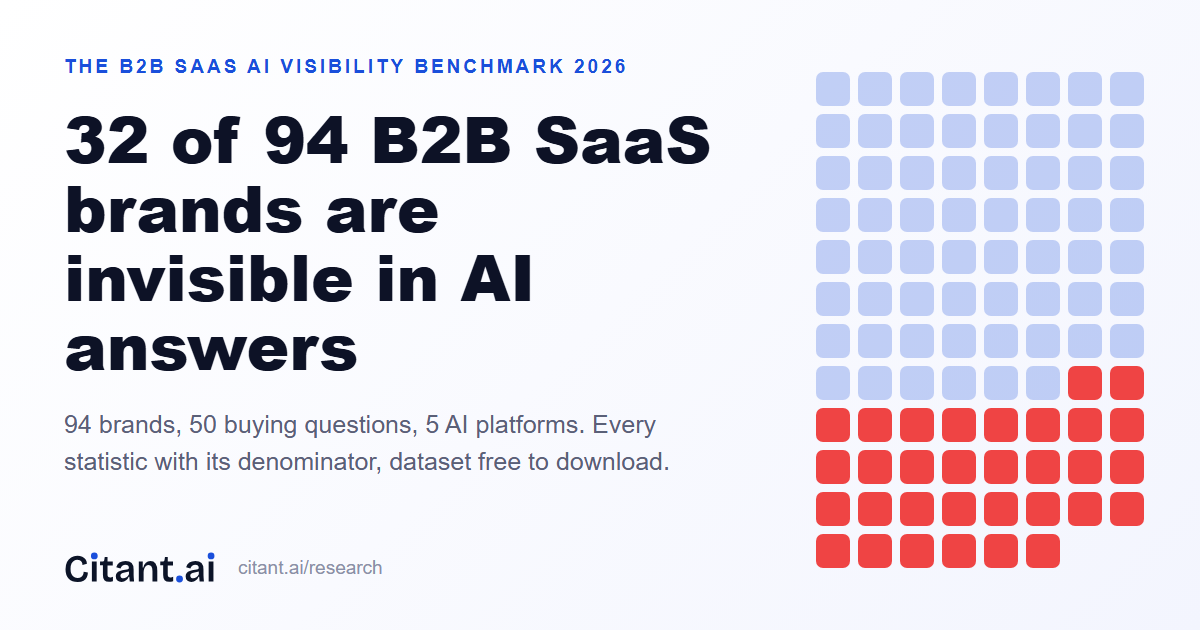
In September 2026, 32 of 94 established B2B SaaS brands (34%) were never named in any AI answer across ChatGPT, Perplexity, Google Gemini, Claude, and Google AI Overviews on 50 real buying questions.
The engines barely share sources (71.6% of the 940 domains they consulted appear on only one engine), yet they largely agree on which brands to name: Claude named 36 of the 39 brands ChatGPT named.
On this page
- 5 AI visibility statistics for B2B SaaS
- How we measured AI visibility
- Finding 1: the AI invisibility rate
- Finding 2: do G2 reviews predict AI visibility?
- Finding 3: the three layers of LLM visibility
- Finding 4: ChatGPT vs Claude vs Perplexity
- Finding 5: which domains do AI engines cite most?
- Finding 6: does crawler access improve AI visibility?
- Finding 7: run-to-run variance in AI answers
- Category deep-dives
- The most-cited domains in AI search
- What these AI search statistics mean for B2B SaaS
- Download the AI visibility dataset
- Frequently asked questions
- Appendix: the 50 questions
Executive summary: 5 AI visibility statistics for B2B SaaS, September 2026
Why these statistics matter. In 6sense’s 2025 Buyer Experience Report, a global study of nearly 4,000 B2B buyers, 94% of buyers said they use LLMs in their buying process, and the winning vendor was already on the buyer’s Day One shortlist 95% of the time. 6sense also found that LLM use has not reduced buyers’ reliance on vendor content or third-party experts, and that buyers lean on LLMs mid-journey, to compare vendors they already know, more than to discover providers at the outset. This benchmark measures which brands those AI answers name.
- 34% of 94 established B2B SaaS brands appeared in zero AI answers across five platforms. 32 of the 94 G2-listed brands we tracked were never mentioned once, on any of the 10 real buying questions in their own category (50 in total), on ChatGPT, Perplexity, Google Gemini, Claude, or Google AI Overviews, in our September 2026 sample.
- 71.6% of the sources AI engines read appear on only one engine. Across 940 distinct domains consulted by ChatGPT, Claude, and Perplexity on the same 50 questions, 71.6% were consulted by exactly one engine and only 8.3% by all three (mean per-question Jaccard similarity 0.022). Yet the shortlists largely agree: Claude named 36 of the 39 brands ChatGPT named.
- ChatGPT reads Reddit but does not quote it. Reddit appeared in ChatGPT’s research pool on 54% of buying questions (27 of 50) and in its cited answers on 2% (1 of 50). YouTube: consulted on 42% (21 of 50), cited on 0%.
- The most-cited source type in ChatGPT answers is the vendor’s own website. 30.7% of ChatGPT’s answer citations (77 of 251) pointed to a tracked vendor’s own domain, double the vendor share of its research pool (15.1% of 1,176). Your website is not optional in AI search.
- Crawlable does not mean visible. The 30 invisible brands we could score average an AI Access Score of 82.0, about the same as the visible brands (84.8; both medians 91), and 24 of them are AI-ready (75 or higher). In this sample, invisibility was mostly not a crawler problem.
The pattern behind all five: AI answer engines read a thin, engine-specific layer of sources (vendor pages, directories, and a long tail of small sites) and name the brands that layer keeps surfacing. Review volume is associated with better odds of being named; it does not guarantee it.
Methodology: how we measured AI visibility across 5 platforms (written so a skeptic can replicate it)
Brand sample. 100 brands were drawn from the default listings of five G2 categories (Project Management, Sales Engagement, Help Desk, Core HR, Vulnerability Scanner) (listings captured September 2 to 3, 2026; the live pages change), taking the first 4 listings per category as Leaders and the next listings as Challengers and Small, with a software-only test applied to every listing.
The tier names are our listing-position labels from that sampling sheet, not G2’s Grid placements and not company size: several Challenger and Small rows carry thousands of G2 reviews (some Small-tier listings carry more than 10,000 total reviews). Findings by review volume therefore use each brand’s recorded G2 review count directly, never the tier label. After deduplicating brands that appeared twice, 94 brand entries remained (93 distinct companies: HubSpot is tracked in two categories); every percentage in this report uses 94 (or the stated subset) as its denominator. On recorded review counts, only 4 brands fall in the 10-to-99 band, so findings for that band carry a small denominator and we say so wherever it is used.
Questions. 50 buyer questions, 10 per category, split across recommendation, comparison, alternatives, trust, and buying-guidance intents. The full list is in the appendix. The set was frozen before data collection; zero edits after.
Platforms and runs. Three platforms were run manually from a clean, memory-off, US-VPN research profile, one new chat per question, prompts pasted verbatim: ChatGPT (web search mode, full conversation payloads exported per run), Claude, and Perplexity, on September 4 to 9, 2026.
Two further platforms, Google Gemini and Google AI Overviews (plus a second, repeated-run ChatGPT series), were sampled through projects on an independent third-party tracking platform on September 7, 2026, at roughly 30 chats per engine per category (3 runs of each question), which provides the repeated-run variance that single manual runs cannot. The zero-mention test also checks every daily tracker run we hold, through September 14, so a brand counted as invisible was not named in its category on any of them. Two of the three tracking projects held two categories each; every repeated-run visibility figure in this report (since dataset v1.3) uses chats from the brand’s own category as the denominator.
What counts as named. A brand counts as named on a question only if its name, domain, or a registered alias appears as a whole word in the final answer text. Source cards and citation links shown beside an answer do not count: a brand whose website appears only there was used as a source, not named.
For brands whose names are common English words (Outreach, Close, Remote, Float, Linear, Intruder, and peers), automated matching uses only the domain or an unambiguous form, and every bare-word occurrence was then read by hand and counted only where the answer refers to the company (the adjudication file ships with the dataset). Text-level tracking on the third-party platform matches bare names, so for those brands its numbers run high and the hand-checked manual numbers govern.
Consulted vs cited. These are different layers and we never mix them. Consulted (or retrieved) means every source that surfaced while an engine researched (ChatGPT: the domains in its search results; Claude and Perplexity: their expanded source lists). On 7 of the 50 questions Claude answered without listing any web source, so it counts as consulting none there. Cited means only the sources referenced in the final answer, which our capture method records for ChatGPT. All cross-engine overlap numbers are computed at the consulted layer; ChatGPT’s cited-versus-consulted split is reported separately.
Conflict of interest, stated. Citant.ai sells Generative Engine Optimization services, including the audit linked at the end of this report. That is exactly why every number here ships with its denominator and the aggregate dataset is downloadable: check us.
Crawler access. Every brand’s website was scanned with our AI Crawler Access Report (21 automated checks across 15 named AI crawlers) on September 5, 2026 and re-scanned on September 26 after a scanner correction (identity-verifying firewalls had been misread as blocks). This report uses the September 26 scores; 84 of the 94 brand entries could be scored.
The scanner tests each crawler by sending its user-agent from our own network, so a site that verifies real crawlers by IP can treat them differently; server logs are the final word.
Manual platforms are single runs at a point in time; AI answers vary run to run, which is why the zero-visibility headline requires zero mentions on all five platforms, two of which (Google Gemini and Google AI Overviews) were sampled at about 30 chats per engine per category (18 to 30 after excluding chats where the platform stored no answer), not one lucky miss. The repeated-run sample covered 3 engines; Microsoft Copilot is not covered in this edition. The sample is US-anchored (US VPN, US English). All figures describe September 2026 and will drift; that drift is measurable, and we intend to re-run the benchmark. Many of the 50 questions are framed for startups and small teams, so large enterprise vendors are a less expected answer to them; read an enterprise brand’s absence in that light. G2 review counts are vendor-wide totals, so for multi-product companies they overstate the review volume of the listed product.
What this data can and cannot show
It can show: how often each brand was named, retrieved, and cited on 50 fixed buying questions in September 2026; how much the engines’ sources overlap; and how crawler access, review volume, and naming line up across 94 brand entries.
It cannot show: why an engine named a brand (every relationship here is an association, not a cause); results outside the US, outside these five categories, or on Microsoft Copilot; or a stable verdict on any single brand, because the manual runs are single snapshots.
Finding 1: the AI invisibility rate in B2B SaaS
32 of 94 brands (34%) were never named on any of their category’s 10 buying questions, on any of the five platforms. This is not a long-tail phenomenon: the invisible group includes two listed category Leaders. ServiceNow (6,876 G2 reviews) and Adobe Workfront (1,234) recorded zero mentions anywhere in the sample, and 16 of the 32 invisible brands carry 1,000 or more G2 reviews.
The zero-visibility bar is strict on purpose: it requires zero mentions across all five platforms plus the repeated-run sample, not one missed answer. Non-leader brands in the invisible group are reported in aggregate.
Named at least once, per manually captured platform (denominator 94): ChatGPT 39, Claude 45, Perplexity 46. ChatGPT names the fewest; Claude and Perplexity are one brand apart.
Finding 2: do G2 reviews predict AI visibility? Odds, not presence
Named at least once by ChatGPT, by G2 review count: 31 of 58 brands with 1,000 or more reviews (53%), 8 of 32 with 100 to 999 (25%), and 0 of 4 with 10 to 99. The listing-position ladder points the same way (Leaders, the first 4 listed per category, 14 of 20; Challengers 17 of 39; Small 8 of 35), and it holds on all three manually run platforms. But the gradient is merciless at the top too: nearly half of the 1,000-plus band was never named. Review counts buy odds, not presence.
Finding 3: named, retrieved, cited: the three layers of LLM visibility
Across all 940 brand-question pairs on ChatGPT (94 brands, 10 category questions each): 21.3% were named in the answer (200), 18.8% had their own site retrieved in ChatGPT’s search results (177), and 8.2% had their own site cited (77). Being talked about, being surfaced, and being quoted are separate outcomes with separate levers. Notably, when a brand’s site was retrieved, it went on to be cited 43.5% of the time (77 of 177); in this sample, getting into the research pool was the harder step.
Finding 4: ChatGPT vs Claude vs Perplexity: different sources, similar shortlists
The 940 distinct domains consulted across ChatGPT, Claude, and Perplexity on identical questions overlap barely at all: 71.6% appear on one engine only, 8.3% on all three. At page level it is starker: ChatGPT and Perplexity shared 66 pages across all 50 questions. (On 7 questions Claude listed no web sources; across the 43 where all three searched, mean three-way Jaccard is 0.025 and pairwise 0.077 to 0.114.) Yet the outcomes largely agree: brand-level named counts have a rank correlation of 0.84 to 0.89 across the three engines, Claude named 36 of the 39 brands ChatGPT named, and 34 of the 54 brands named by at least one manual engine were named by all three. The engines reach similar shortlists through different sources, so source work has to be planned per engine even when the shortlist looks the same.
Where the engines do diverge is tone, and Google’s engines against ChatGPT. In our repeated-run sample, Google AI Overviews described brands more positively than ChatGPT for 24 of the 25 brands scored by both, by a median of 18 points on a 0-to-100 scale (Apollo.io 77 vs 54, ClickUp 75 vs 57, Asana 73 vs 55). ChatGPT is the critic; AI Overviews is the promoter. (Sentiment is the tracking platform’s own score and is noisy for brands with few mentions.)
The cleanest single exhibit: Aikido Security, a security vendor with 260 G2 reviews, appeared in 43% of Google AI Overviews chats (13 of 30) and 27% of Gemini chats (8 of 30) in its category, and 3% of ChatGPT chats (1 of 30). Same brand, same week, three different verdicts.
Finding 5: which domains do AI search engines cite most? What ChatGPT’s citations show
ChatGPT’s cited-source mix across 251 prompt-domain citations: 30.7% vendor-own domains, 3.6% review and UGC platforms (G2, Capterra, Reddit, YouTube, TrustRadius combined), 0.4% mainstream editorial, 2.0% institutional (.org and .edu), and 63.3% all other domains: untracked vendors, small blogs, tool directories, niche listicles, and publishers outside our short editorial list. That bucket is 74.9 to 85.9% of the three engines’ research pools.
Concretely, the sites feeding B2B SaaS answers in our sample include stackfyi.com (retrieved in 19 of 179 tracked Project Management and Sales Engagement chats and cited 28 times; tracking-platform export, available on request), getmacha.com (consulted on 7 of 10 Help Desk questions, cited on 3), toolradar.com (the top cited third party in Core HR), and taskrhino.ca (cited 3.6 times per chat it was retrieved in). Meanwhile G2 was retrieved about twice as often as it was quoted, and Reddit’s consulted-to-cited collapse (54% to 2%) repeats for YouTube (42% to 0%).
Security is a different playbook: the top cited third parties in the Vulnerability Scanner category were vendor education and institutional pages (arxiv.org on 4 of 10 questions, detectify.com and snyk.io on 3 of 10 each, plus owasp.org), with G2 cited on 2 of 10 questions. The winning content strategy is category-specific and measurable.
Finding 6: does crawler access improve AI visibility? Not on its own
Most of the 32 invisible brands are not blocked: on the corrected September 26 scan, 24 of the 30 we could score are AI-ready (AI Access Score 75 or higher), and the invisible group’s mean score (82.0) is about the same as the visible group’s (84.8; both medians 91; permutation test p = 0.53).
Blocking is not what decides naming either way. Rippling, whose scan showed ChatGPT’s crawlers refused (AI Access Score 19), was still named by ChatGPT on 9 of its 10 questions, and its site was retrieved on 6 and cited on 2. Two other sites refused our test crawlers including Google’s and Microsoft’s search crawlers, the pattern of an identity-verifying firewall that may admit the real crawlers; one of them, Salesforce, was named on 6 of 10. Our scanner sends each crawler’s user-agent from our own network, so server logs are the final word. Letting crawlers in is still worth doing; it is not what separated the brands here.
The free scan checks whether AI systems can reach the site. The $440 AI Search Audit measures whether they name the brand.
Finding 7: run-to-run variance in AI answers (why single-run studies mislead)
Our repeated-run sample logged roughly 30 chats per engine per category on September 7 (3 runs of each question). Visibility percentages there are averages over dozens of runs, and they differ from any single run: Asana, named on every one of its 10 manual ChatGPT questions, appeared in 28 of 30 repeated ChatGPT chats (93%) and 19 of 30 Google AI Overviews chats (63%), so a single AI Overviews screenshot misses it more than a third of the time. Judge AI visibility on sampled rates, never on one screenshot, and treat any study that does not state its run counts accordingly.
Category deep-dives
Project Management
ChatGPT consulted 24.2 domains per question and cited 4.3 (overlap file). Atlassian, Asana, ClickUp, and monday.com dominate; Adobe Workfront recorded zero mentions anywhere, along with five non-leader brands reported in aggregate (6 of the category’s 20 tracked brands). Repeated-run visibility across the three tracked engines (90 chats): Atlassian 81%, ClickUp 79%, Asana 77%.
Sales Engagement
The most Reddit-heavy category (consulted on 8 of 10 questions), yet Reddit was cited on 1. Apollo.io is the category’s citation king: its own site drew 86 citations across 34 chats in the tracking-platform export, the highest self-citation count in the study. Repeated-run visibility across the three tracked engines: Apollo.io 87% (77 of 89 chats).
Help Desk
The category where the engines agree least on sources: the lowest cross-engine overlap in the study (mean ChatGPT-to-Claude Jaccard 0.034 on the questions where both searched) and a citation layer led by small sites (getmacha.com cited on 3 of 10 questions). Zendesk, Intercom, and Freshworks cluster at 72% to 73% on repeated runs; ServiceNow: zero everywhere, along with 9 more of the category’s 18 tracked brands, reported in aggregate.
Core HR
A visibility duopoly: Rippling 90% and Gusto 86% on repeated runs, then a group at 62% to 66%, and a cliff to 25% by sixth place. YouTube was consulted on 8 of 10 ChatGPT questions here and cited on 0. Four of the category’s 17 tracked brands recorded zero mentions anywhere; non-leader brands are reported in aggregate.
Vulnerability Scanner
The fewest consulted domains (15.7 per ChatGPT question) and the most institutional citation layer (arxiv.org, owasp.org). Tenable runs strong at 43% to 57% repeated-run visibility across the three tracked engines (30 chats each); CrowdStrike appeared in 1 of 30 chats on each. The category shows a vendor with 260 G2 reviews can far outrun larger ones on one engine: Aikido Security appeared in 13 of 30 Google AI Overviews chats against CrowdStrike’s 1 of 30 (see Finding 4).
The most-cited domains in AI search, by category
These are the third-party hosts ChatGPT cited most often per category, with how many of the category’s 10 questions each was cited on. Read this table as a placement map: these are the hosts ChatGPT quoted when B2B SaaS buyers asked their questions in September 2026 (ties beyond the top rows are in the cited-domains file).
| Category | Most-cited third-party hosts (questions cited on, of 10) |
|---|---|
| Project Management | toggl.com (2 of 10 questions); agencypro.app (1 of 10 questions); aitecharchive.com (1 of 10 questions) |
| Sales Engagement | smartlead.ai (4 of 10 questions); destackd.com (3 of 10 questions); revenueflow.com (2 of 10 questions) |
| Help Desk | getmacha.com (3 of 10 questions); capterra.com (2 of 10 questions); helpdesk.com (2 of 10 questions) |
| Core HR | toolradar.com (3 of 10 questions); compono.com (2 of 10 questions); hrsoftwarepick.com (2 of 10 questions) |
| Vulnerability Scanner | arxiv.org (4 of 10 questions); detectify.com (3 of 10 questions); snyk.io (3 of 10 questions) |
What these AI search statistics mean for B2B SaaS marketing leaders
Whether a team runs this work as generative engine optimization (GEO), answer engine optimization (AEO), or AI SEO, the levers are the same five:
- Measure per platform, or the numbers mislead. The engines read almost entirely different sources, and Google’s engines can rate the same brand very differently from ChatGPT (see Aikido Security).
- A vendor’s own site is its biggest single citation asset on ChatGPT (30.7% of citations). Make sure the pages ChatGPT retrieves answer buying questions directly.
- The long tail of third-party pages is the new distribution. Domains outside the tracked brands (other vendors, small blogs, directories, listicles) make up most of what ChatGPT cites. They are reachable.
- Reddit-first strategies are mismeasured. Read constantly, quoted almost never in this vertical’s buying questions.
- Crawler access is a fast fix and only the start. 80% of the invisible brands we scored (24 of 30) are already AI-ready and still invisible.
Download the AI visibility dataset: citation, license, replication
The aggregate dataset is free to download and reuse with attribution (CC BY 4.0): the 50 questions (CSV), per-brand results across platforms (CSV), per-question cross-engine source overlap (CSV), summary metrics behind every aggregate in this report (CSV), cited and retrieved third-party domains by category (CSV), repeated-run tracker figures per engine (CSV), the hand reads behind the zero-mention test (CSV), the Claude and Perplexity recount behind dataset v1.4 (CSV), and a data dictionary (CSV). Single-run captures include full conversation payloads for ChatGPT, and screenshots exist for every manual run; researchers and journalists can request them at hamza@citant.ai.
Charts for your article. All 10 charts as 2x PNGs, each self-contained with its source line, free to reuse with a credit and a link to this page: download the chart pack (ZIP). Credit line: “Source: Citant.ai, The B2B SaaS AI Visibility Benchmark 2026.”
Ask an AI about this report: ChatGPT, Perplexity, Claude.
Suggested citation: Citant.ai (2026). The B2B SaaS AI Visibility Benchmark 2026 (dataset v1.4). https://citant.ai/research/b2b-saas-ai-visibility-benchmark-2026/
What the results file contains. One row per brand per category (HubSpot competes in two categories, so it has two rows; 94 rows).
For each manual platform, the number of the category’s 10 questions on which the brand was named; ChatGPT own-site retrieved and cited counts; the September 26 and September 5 AI Access Scores (blank where the site could not be scored); the third-party tracking visibility within the brand’s own category (ChatGPT, Gemini, and AI Overviews combined; per-engine figures are in the tracker file) with its status; a common-word-name flag; and the two zero-visibility flags used in Finding 1. Tier is the listing-position label described in the method.
Corrections, October 8, 2026 (dataset v1.2).
- A hand read of every bare-word mention of common-word brand names found companies named that the automated domain-only match had missed: brands named at least once moved from 38 to 39 (ChatGPT), 44 to 46 (Claude) and 49 to 52 (Perplexity), and named brand-question pairs on ChatGPT from 180 to 200 (every decision in the adjudication file (CSV)).
- front.com, Front’s own domain, had been classed as a third party: own-site retrieved moved from 172 to 177 and cited from 75 to 77, and the vendor share of ChatGPT citations from 29.9% to 30.7%.
- Crawler-access figures moved to the corrected September 26 scan, which changed the invisible and visible means from 73.7 and 83.9 to 83.5 and 84.0. The v1.3 group change below later made them 83.7 and 83.9.
- Finding 4 now reports that the engines agree on most brands while reading different sources; three category denominators and the tier description were corrected.
The 30-of-94 zero-visibility headline was unchanged by these.
Corrections, October 8, 2026 (dataset v1.3).
- Repeated-run visibility now uses chats from the brand’s own category as the denominator. Two of the three tracking projects held two categories each and the platform divided by both, which halved the published rates for Project Management, Sales Engagement, Help Desk, and Core HR (for example Atlassian 41% became 81%). Vulnerability Scanner was unaffected.
- The repeated-run sample is one day, September 7, 2026 (3 runs of each question per engine), not September 5 to 7 as earlier versions said.
- The zero-mention test now checks every daily tracker run we hold (September 7 to 14), counts only mentions in the brand’s own category, and reads common-word hits by hand, as the manual engines always did. Two brands left the invisible group (both named in their category on later runs, among them Smartsheet, our earlier lead example) and two joined (one whose only hit was an answer in another category, one whose hits were all the common word). The count stayed 30 of 94. The hand reads are published as their own file.
- Crawler-access figures then followed the new group: 23 of 28 scored invisible brands were AI-ready; mean scores 83.7 vs 83.9 (v1.4 below moved them again).
- Wording that implied causation, a refused-crawler exhibit that mixed in identity-verifying firewalls, the listing-tier label, per-category candidate counts, and the 6sense context were corrected.
Corrections, October 13, 2026 (dataset v1.4).
- Every Claude and Perplexity named count was recounted on the answer text alone, with each match checked in its sentence and every common-word name read by hand. The v1.3 counter skipped any transcript paragraph that carried a citation link, which missed brands named in those paragraphs, and it counted source-card labels and citation links that sat on a line of their own, which credited brands whose websites were only listed as sources. Brands named at least once moved from 46 to 45 (Claude) and from 52 to 46 (Perplexity). ChatGPT, counted from full conversation payloads, is unchanged at 39. Every Claude and Perplexity cell, with the questions counted, is in the recount file (CSV).
- Two brands whose only Perplexity appearance was a source card or a citation link joined the invisible group, which is now 32 of 94 (34%), up from 30 of 94. No brand left it; ServiceNow and Adobe Workfront are unchanged.
- Figures that follow the group: 16 of the 32 invisible brands carry 1,000 or more G2 reviews; 24 of the 30 scored invisible brands are AI-ready; mean AI Access Scores are 82.0 (invisible) and 84.8 (visible), previously 83.7 and 83.9.
- Cross-engine agreement: Claude named 36 of the 39 brands ChatGPT named (was 35); 34 of the 54 brands named by at least one manual engine were named by all three (was 33 of 60); the rank correlation of named counts across engines is 0.84 to 0.89 (was 0.78 to 0.85). Figure 2 no longer says Perplexity names the most brands: Claude (45) and Perplexity (46) are one brand apart.
This is Edition 1. AI answers drift, so the benchmark is designed to be re-run; later editions will report what changed against this baseline.
Frequently asked questions
What percentage of B2B SaaS brands appear in AI search results?
In our September 2026 sample of 94 established B2B SaaS brands, ChatGPT named 39 of 94 at least once (41%), Claude 45 of 94 (48%), and Perplexity 46 of 94 (49%) on 50 buying questions. 32 of 94 (34%) were never named by any of five platforms, including Google Gemini and Google AI Overviews.
Which domains do AI search engines cite most?
For B2B SaaS buying questions, ChatGPT is the engine we can measure at the citation level: 30.7% of its answer citations went to the vendors' own websites and 63.3% to other domains outside our review, editorial, and institutional lists (mostly small blogs, tool directories, niche listicles, and untracked vendors). Review platforms including G2, Capterra, Reddit, and YouTube together took 3.6%, and mainstream editorial 0.4%, across 251 prompt-domain citations in September 2026.
Does Reddit presence drive AI search visibility for B2B SaaS?
Less than assumed. ChatGPT consulted Reddit while researching 54% of our 50 buying questions but cited it in the final answer on 2% (1 of 50). YouTube was consulted on 42% and cited on 0%. The quoted layer is vendor sites, including untracked vendors, plus small blogs, directories, and listicles.
How do you get cited by ChatGPT?
In this sample the strongest levers were a brand's own site and the long tail of third-party pages: vendor-own domains took 30.7% of ChatGPT's answer citations, a brand site that surfaced in ChatGPT's search results went on to be cited 43.5% of the time (77 of 177), and 63.3% of citations went to other domains (untracked vendors, small blogs, directories, listicles). Crawler access is worth fixing, but it is not what separated named from unnamed brands here: a brand was named and retrieved even where our scanner showed ChatGPT's crawlers refused.
Does ChatGPT cite Reddit and G2?
Rarely, in this sample. ChatGPT read Reddit on 54% of B2B SaaS buying questions (27 of 50) but cited it on 2% (1 of 50), and read YouTube on 42% (21 of 50) without citing it once. Review and community platforms combined (G2, Capterra, Reddit, YouTube, TrustRadius) took 3.6% of ChatGPT's answer citations; other domains (untracked vendors, small blogs, directories, listicles) took 63.3% and tracked vendors' own sites 30.7%.
Why does ChatGPT recommend competitors instead of my brand?
In this sample, invisible brands were rarely blocked. 24 of the 30 brands we could score that appeared on none of the five platforms were AI-ready (AI Access Score 75 or higher on the corrected September 26 scan), and even among brands with 1,000+ G2 reviews, 27 of 58 were never named by ChatGPT. What ChatGPT did cite: 63.3% of its citations went to other domains (untracked vendors, small blogs, directories, listicles), and a brand site that surfaced in its search results went on to be cited 43.5% of the time. The lever is presence on the pages ChatGPT reads for your category.
How was this benchmark measured?
50 buyer questions, frozen before collection, were run across ChatGPT, Claude, and Perplexity manually (clean US profile, one new chat per question, full payload capture for ChatGPT) on September 4 to 9, 2026, and across Google Gemini, Google AI Overviews, and a repeated-run ChatGPT series via tracking projects at roughly 30 chats per engine per category. A brand counts as named only on a whole-word or domain match in the final answer text; source cards and citation links do not count. The dataset is downloadable above under CC BY 4.0.
About Citant.ai
Citant.ai is a generative engine optimization (GEO) agency, also called an AI search optimization or AI SEO agency, that gets B2B SaaS companies cited, recommended, and represented in AI answers across ChatGPT, Perplexity, Google Gemini, Claude, Microsoft Copilot, and Google AI Overviews. Our work follows the 4-Layer Citation Framework: Retrieval, Re-ranking, Generation, and Meta Distribution.
We run the free AI Crawler Access Report (21 automated checks across 15 named AI crawlers) and a $440 AI Search Audit that maps exactly which questions, engines, and sources your brand is missing from, credited in full against the GEO Pilot if the Pilot is signed within 30 days of audit delivery. Every GEO Pilot carries one published guarantee: your brand named on at least 3 of the 10 agreed target queries across at least 2 of the 6 tracked platforms within 9 weeks, or every Pilot payment is refunded, initiated from our side within 24 hours of the week-9 review. Funds return through the original payment rail, typically within 5 business days. Full terms: /guarantee/. Questions about the data: hamza@citant.ai.
Related research and guides
Appendix: the 50 questions
The full frozen question set, grouped by category, exactly as pasted into each platform.
Project Management
- Best project management software for a 50-person software company
- Best project management tool for startups
- Asana alternatives for small teams
- Jira alternatives for startups
- Which project management tool is best for remote engineering teams
- Project management software with the best free plan for startups
- Is monday.com worth it for a small business
- Simplest project management app for non-technical teams
- Best project management software for agencies managing client work
- How do I choose a project management tool for a growing SaaS team
Sales Engagement
- Best sales engagement platform for a Series A SaaS startup
- Best sales engagement software for small B2B sales teams
- Outreach alternatives for startups
- Salesloft vs Outreach for a 10-person sales team
- Which sales engagement tool has the best email deliverability
- Affordable sales engagement platform for SDR teams under 10 people
- Is Apollo worth it for outbound sales
- Best tool to automate outbound sales sequences for a startup
- Sales engagement platforms that integrate with HubSpot
- How to choose a sales engagement platform for a B2B startup
Help Desk
- Best help desk software for a SaaS startup
- Best customer support software for small teams
- Zendesk alternatives for startups
- Intercom vs Zendesk for a small SaaS company
- Affordable help desk software with live chat for startups
- Which customer support platform is best for B2B SaaS
- Is Freshdesk worth it for a small business
- Best help desk tool with an AI chatbot for a small support team
- Customer support software that integrates with Slack
- How to choose customer support software for a growing SaaS
Core HR
- Best HR software for a 50-employee startup
- Best HRIS for small businesses
- BambooHR alternatives for startups
- Rippling vs Gusto for a small company
- Affordable HR software with payroll for startups
- Which HR platform is best for remote-first companies
- Is Deel worth it for hiring international employees
- Best HR software for onboarding new hires at a small company
- HR software for startups under 100 employees
- How to choose an HRIS for a growing startup
Vulnerability Scanner
- Best vulnerability scanner for a startup
- Best vulnerability management tool for small companies
- Tenable alternatives for startups
- Intruder vs Detectify for a small SaaS
- Affordable vulnerability scanning for a SaaS with no security team
- Which vulnerability scanner is best for cloud-native startups
- Is Qualys worth it for a small company
- Best external attack surface scanner for startups
- Vulnerability scanning tools that help with SOC 2 compliance
- How to choose a vulnerability scanner for a startup