
Citant.ai Case Study: How AI Assistants Became AI-Toolbox.co’s Top Source of Paying Customers
Every number on this page traces to a dated export: a 678% increase in top-3 Google rankings, three AI platforms independently producing verified sales, and organic clicks that kept compounding for a month after the work stopped.
Citant.ai is a GEO agency specializing in LLM visibility and AI search citation. AI-Toolbox.co is a Chrome extension that manages ChatGPT, Claude, and Gemini conversations for a base that reached 30,842 weekly active users during this engagement. The pre-Pilot GEO sprint on AI-Toolbox.co ran between April and June 2026 and covered entity correction, citation structure, page consolidation, and transaction-level revenue attribution. By Week 4 of that sprint, AI assistants had become the largest attributed source of paid conversions for the product, ahead of Google organic search, while accounting for roughly 6% of site sessions. This page reports every measured result from the engagement, including the two tracked platforms where citation counts fell.
Client named with written permission Every figure traced to a dated export
The short answer
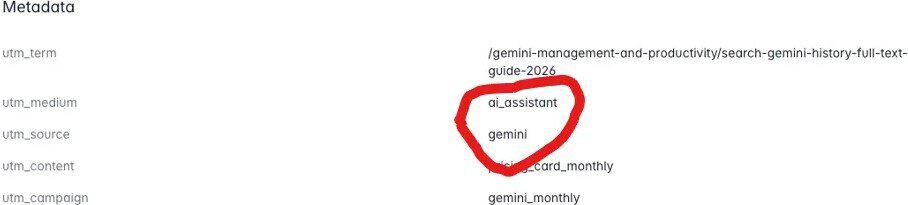
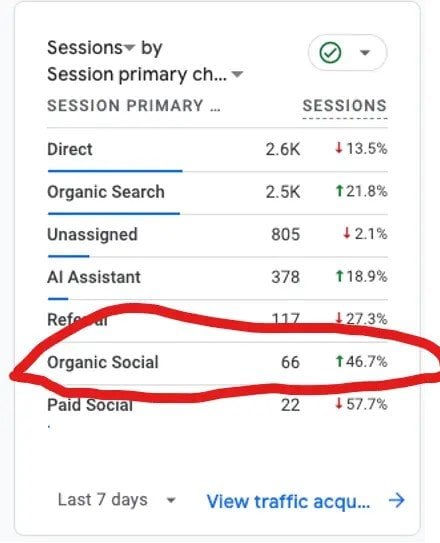
In the AI-Toolbox.co engagement, 5 of 11 attributed paid conversions came from AI assistants in Week 4, roughly 45%, and all five arrived through ChatGPT. Over the same period AI assistant referrals accounted for roughly 6% of total site sessions, 378 of 6,408.
Every one of those conversions was verified to an individual payment record carrying a source parameter.
Delivered within 72 hours of kickoff, and credited in full against a GEO Pilot signed within 30 days.
The results in one table
Ten measured outcomes from the AI-Toolbox.co engagement, each with the basis on which it was counted and the date it was measured. Two tracked platforms finished below their starting point and appear further down this page with the cause identified.
| Result | Before | After | Change | Basis | Measured |
|---|---|---|---|---|---|
| Attributed paid conversions from AI assistants | 0 of 0 tracked | 5 of 11, roughly 45%, from roughly 6% of sessions | New attributed channel | All AI assistants, all five via ChatGPT | Week 4 |
| AI assistant share of all site sessions | Not tracked | Roughly 6%, 378 of 6,408 | New measurement | All sessions, all channels | 22 to 28 June 2026 |
| ChatGPT citations | 58 | 110 | Up 90% | Distinct cited pages and queries | 27 April to 29 June 2026 |
| Google AI Overview citations | 8 | 22 | Up 175% | Distinct cited pages and queries | 27 April to 29 June 2026 |
| Citations across the five measured AI platforms combined | 130 | 166 | Up 28% | ChatGPT, AI Overviews, Gemini, Perplexity, Copilot | 27 April to 29 June 2026 |
| Top-3 Google rankings | 9 | 70 | Up 678% | Tracked keyword set | 27 April to 29 June 2026 |
| Google organic sessions, weekly | Roughly 700 | Roughly 2,500 | Up 257% | All organic sessions | 27 April to 29 June 2026 |
| AI assistant referral sessions, weekly | Roughly 100 | 378 | Up 278% | Named AI Assistant channel | 27 April to 29 June 2026 |
| On-site purchaser rate | 0.3% | 0.9% peak | Roughly 3x | All sessions, all channels | 27 April to 29 June 2026 |
| Weekly active users of the extension | 26,029 | 30,842 | Up 18.5% | Weekly active installs | Final week of the sprint |
| Share of Authority, Microsoft AI surfaces | Not tracked | 21.3%, 7,380 of 34,609 citations | New measurement | Copilot and Bing generative search only | 23 to 29 June 2026 |
Who AI-Toolbox.co is and what the sprint covered
AI-Toolbox.co is a Chrome extension that organizes and manages conversations across ChatGPT, Claude, and Gemini. The product had recently rebranded from a single-platform tool into a three-platform extension, reached 30,842 weekly active users during the engagement, and held a 4.47 store rating across 342 ratings throughout. The client gave written permission to be named on this page.
Baseline measured . Active execution ran to : one audit week plus four execution weeks. The engagement then paused while the client tested paid acquisition. That pause is reported here rather than hidden, because the month that followed produced the most useful evidence in this case study.
This was a pre-Pilot GEO sprint, not a GEO Pilot. Citant.ai is a GEO agency specializing in LLM visibility and AI search citation, and the GEO Pilot is the current productized nine-week engagement with a contractual citation guarantee attached. The differences between the two are set out near the end of this page.
What was broken before the sprint
Five diagnosed failures, all identified in the audit week and all documented in the client report.
AI assistants were still recommending a product name that no longer existed
ChatGPT, Gemini, and Perplexity were citing the pre-rebrand brand name. A user who asked an AI assistant for a conversation manager received a recommendation pointing at a product identity the company had retired. Entity inconsistency of this kind does not reduce citation volume. It redirects the value of every citation to a name the buyer cannot find.
87% of organic traffic sat on a single page
One page, built around a retired ChatGPT model, carried 87% of all organic traffic to the site. A single de-ranking event would have removed the organic channel. Concentration risk of that shape is invisible in a traffic chart that points upward, which is why it survives most audits.
Ten pages were competing for the same commercial queries
The site carried five AIPRM pages, two Sider pages, and three archive pages targeting overlapping commercial queries. When several URLs on one domain answer the same question, no page accumulates enough authority to be identified as the canonical source, and retrieval systems have no clear candidate to cite.
High-visibility pages were structurally uncitable
The site’s most visible pages carried no FAQ schema, no formal references sections, and author markup that resolved to nothing. Those pages were drawing 358,000 or more weekly Google impressions at roughly a 0.3% click-through rate. Impressions without structure produce visibility without citation.
No revenue attribution existed
Checkout carried no source parameters, so no sale could be traced to the channel that produced it. Without that link, the question a founder actually asks about AI search has no answer: does a citation inside an AI assistant sell software, or is it a metric that only looks like progress.

What Citant.ai did
Four moves, executed in order, each mapped to a layer of the 4-Layer Citation Framework. No paid placements, no purchased links, and almost no new pages.
Citation infrastructure before new content
The first week corrected Article and HowTo schema, published a real author page, added formal references sections with retrieval dates, applied FAQ formatting to the highest-visibility pages, and aligned brand naming across every surface an AI system indexes, from the Chrome Web Store listing to video descriptions. Factual errors on key pages were corrected in the same pass. This work targets the Retrieval layer, which decides whether content enters an AI system’s context window at all.
Consolidation instead of creation
The original plan called for new comparison articles. A sitemap review found near-duplicate pages already competing for those exact queries, so the sprint merged, redirected, and updated them instead. New pages published during the sprint: close to zero, by design. This work targets the Re-ranking layer, where concentrated authority on one URL outscores the same authority split across four.
Syndication matched to each platform’s sources
Different AI platforms draw on different source types, so each received material in the format it favors. Long-form syndication served Perplexity. Community forums served Perplexity, Microsoft Copilot, and Grok. Short-form posts served Grok. This work targets the Meta Distribution layer, which no amount of on-page optimization can reach.
Revenue attribution down to the individual sale
Checkout was rebuilt to carry source parameters, so every paid conversion recorded whether it originated from Google organic, direct, or a named AI assistant. This is the move that separates a citation count from a revenue claim, and it is the reason the numbers on this page can be stated as conversions rather than as visibility.
The six tracked platforms are ChatGPT, Perplexity AI, Google Gemini, Claude, Microsoft Copilot, and Google AI Overviews. Grok is not one of them. The audit surfaced Grok activity on this domain and the sprint acted on it, which is what an audit is for.
Week by week: what changed and when
Citation counts and ranking counts moved in every measured week of the sprint, which is the pattern that distinguishes a structural fix from a single fortunate week.
| Week | ChatGPT citations | Top-3 Google rankings | Attributed paid conversions from AI assistants | Notable event |
|---|---|---|---|---|
| Baseline, 27 April 2026 | 58 | 9 | Not tracked | Audit and baseline export |
| Week 2 | 90 | 26 | 1 | First paying customer ever attributed to an AI assistant, via ChatGPT |
| Week 3 | 94 | 35 | 4 of 9, 44%, from roughly 6% of sessions | Perplexity produced its first attributed sale |
| Week 4 | Not exported | 51 | 5 of 11, 45%, from roughly 6% of sessions | AI assistants became the largest attributed conversion source |
| Week 5, 22 to 28 June 2026 | 110 | 70 | Recorded, count pending export | First paying customer attributed to a Google Gemini recommendation |
Did AI citations produce paying customers?
Yes, and each sale was traced to an individual payment record rather than inferred from a traffic pattern.
Three AI platforms produced verified paid conversions
ChatGPT produced the first attributed sale in Week 2 and produced more in every week afterward. Perplexity produced its first in Week 3. Google Gemini produced its first in Week 5. Each of those sales carried a source parameter recorded at checkout and was matched to an individual transaction in the payment provider record, which is a different standard of evidence from a correlation between a citation count and a revenue chart.
The Week 4 result, stated precisely
Of 11 attributed paid conversions in Week 4, 5 came from AI assistants, roughly 45%, and all five arrived through ChatGPT. AI assistant referrals accounted for roughly 6% of site sessions over the same engagement. That made AI assistants the largest single attributed conversion source for the week, ahead of Google organic search, in the highest-converting week of the sprint. In Week 3 the equivalent figure was 4 of 9, 44%, on the same all-AI basis, of which three came from ChatGPT and one from Perplexity.
Six percent of sessions, forty-five percent of conversions
The contrast is the finding, not the conversion figure on its own. AI assistant referrals accounted for roughly 6% of site sessions in the final measured week, 378 of 6,408, and produced 44% to 45% of attributed paid conversions in the two weeks where both were measured. A visitor arriving from an AI recommendation has already had the problem named and a solution proposed, which is why that traffic converts like a referral rather than like search traffic. For the measurement framework behind claims of this kind, our guide to how to measure GEO return on investment sets out the method.
How AI visibility changed across tracked platforms
Citation counts rose on three of the five measured platforms and fell on two. All five movements are reported here.
Share of Authority on Microsoft AI surfaces reached 21.3%
In the week of 23 to 29 June 2026, AI-Toolbox.co held a 21.3% Share of Authority across Microsoft AI surfaces: 7,380 citations attributed to the domain against 27,229 attributed to all other cited domains in the same query set. This figure covers Microsoft Copilot and Bing generative search only. It does not measure ChatGPT, Gemini, or Perplexity, and it is not a measurement of the whole product category or of the whole web.
Two measurement scales, and why they differ
Citation figures on this page come from two systems that count different units. One reports distinct cited pages and queries per platform, which is why ChatGPT appears as 110. The other counts individual citation instances across its tracked query set, which is why the same domain appears with figures in the thousands. Neither is wrong and neither is comparable to the other, so each figure on this page is labeled with the system that produced it.
The most-cited page on the site is the one whose facts were corrected
A single page, the ChatGPT models comparison guide, recorded 3,172 citation instances across Microsoft AI surfaces after its outdated model information was corrected. In this engagement, factual accuracy and citation volume moved together on the same URL, which is the clearest single piece of evidence the sprint produced about what AI systems reward.
Query-level share on named commercial questions
Across Microsoft AI surfaces in the same measured week, AI-Toolbox.co held 64.7% of citations for “which chatgpt model is free,” 53.5% for “chatgpt apps,” and 52.2% for “chatgpt thinking,” alongside 100% share on a set of long-tail questions. Query-level share matters more than aggregate share, because a buyer asks one question at a time.
An unmeasured platform was already citing the site
The audit found Grok citing the domain 160 times across 27 pages before any work began. Those citations were discovered, not earned, and they are reported that way. A channel nobody is measuring cannot be managed, defended, or grown.
What happened to Google rankings and organic traffic
Top-3 Google rankings grew from 9 to 70 across five weekly measurements: 9, 26, 35, 51, 70. That progression came from a consolidated page set concentrating authority, not from a single keyword breaking through.
Weekly Google organic sessions grew from roughly 700 to roughly 2,500, and grew a further 21.8% in the final week alone, after paid campaigns had been wound down. Organic growth that accelerates while paid spend decreases is organic growth, not paid spillover.
The concentration risk was also resolved. The site entered the sprint with one page carrying 87% of organic traffic and left it with a distributed set of ranking, cited pages. For a marketing leader, removing a single point of failure from the acquisition channel is worth more than the ranking count that produced it.
What happened after the sprint paused
The engagement paused at the end of June while the client tested paid acquisition. No GEO work was performed on the domain during July.
Search Console reported 28-day click milestones of 1.2K on , 1.5K on , 7K on , and 11K on . The 30 July window falls entirely after the sprint ended. Structural work shipped in June continued compounding through July with no active work on the account.
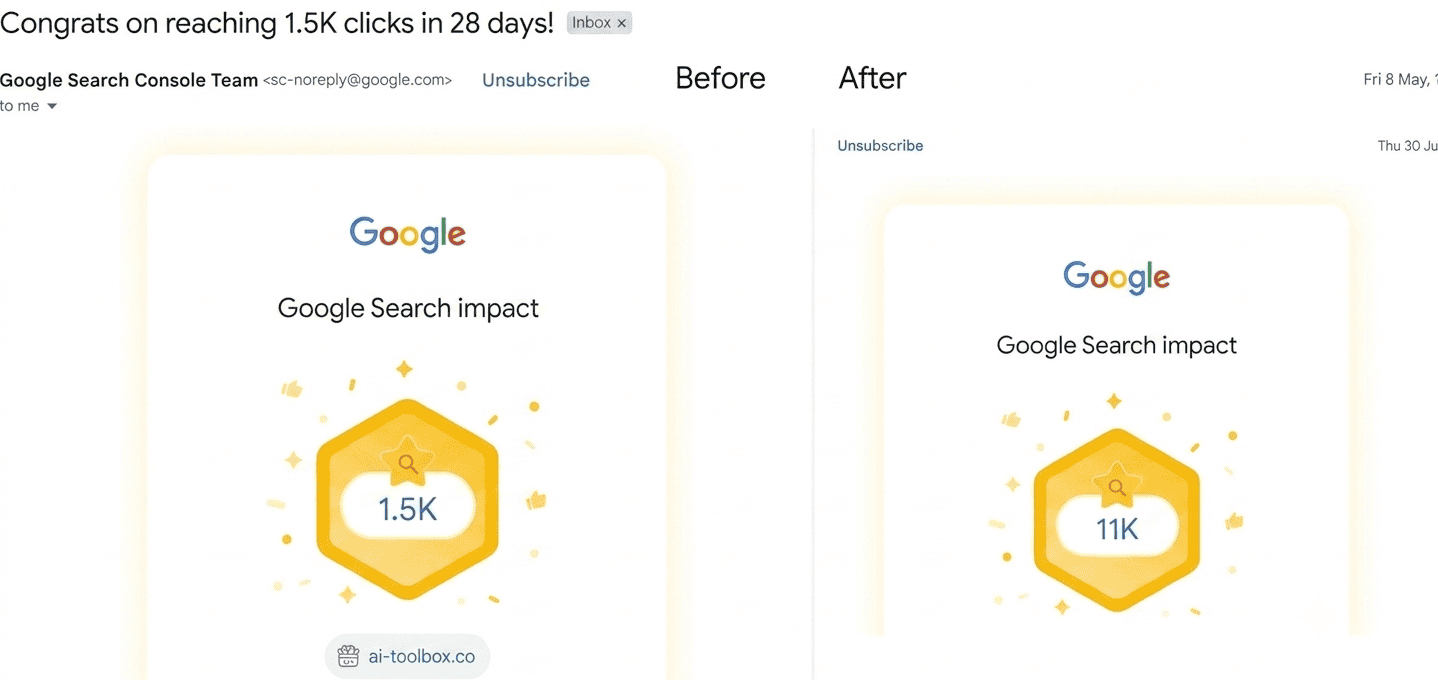
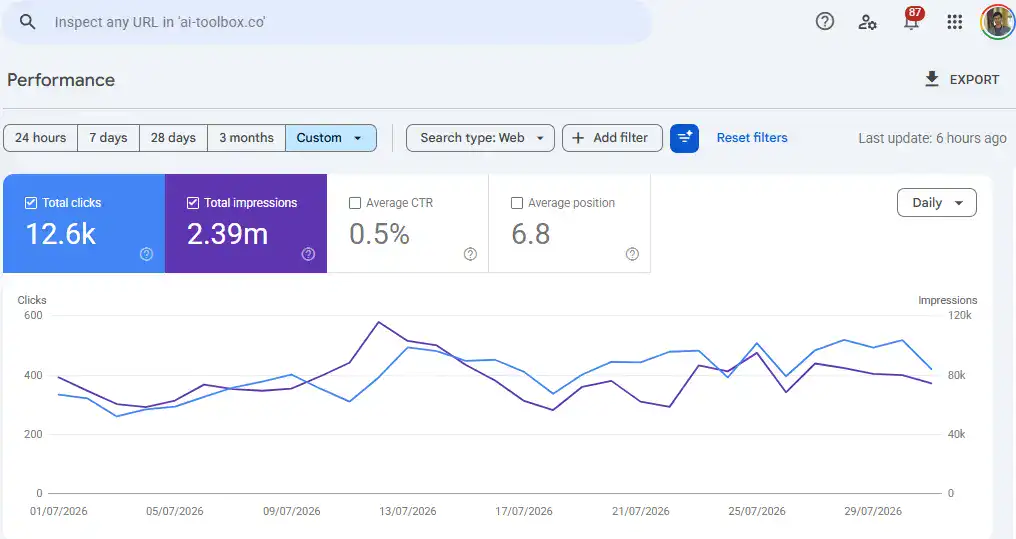
July 2026 was also measured as a calendar month. The property recorded 12.6K clicks and 2.39M impressions between and , its largest calendar month in the 16 months of available data, with 103 pages earning their first impressions, on Google’s estimate. The 11K figure above is a rolling 28-day window ending 30 July; the 12.6K figure is the calendar month of July. Both come from Search Console and neither replaces the other, so both are labeled.
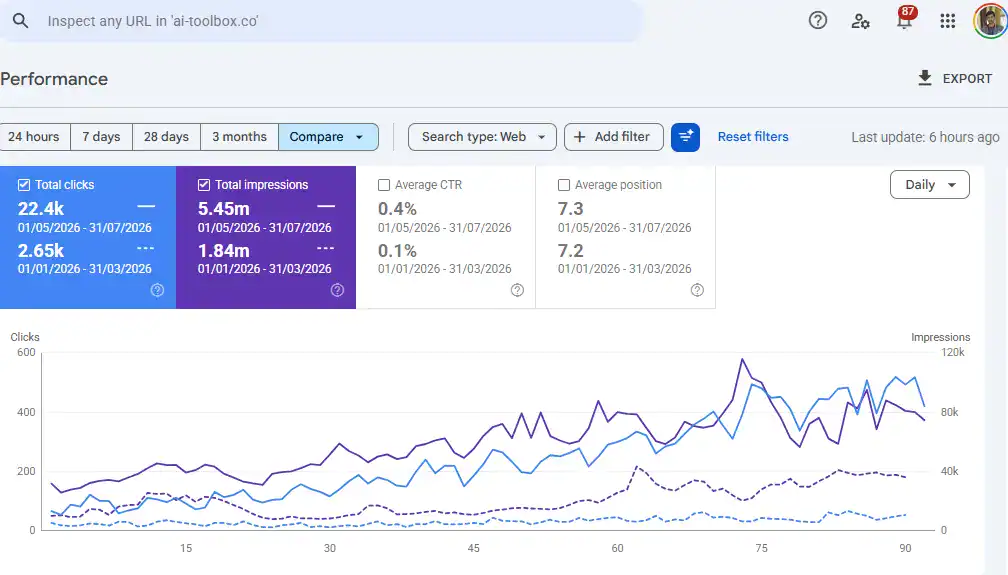
Comparing the three months after the sprint against the three months before it, with April excluded as the transition month: clicks rose from 2.65K between and to 22.4K between and , an increase of roughly 745%. Impressions rose from 1.84M to 5.45M. Click-through rate rose from 0.1% to 0.4%. Average position held roughly flat, 7.2 against 7.3, across an impression base three times larger, which is the expected shape when a site begins appearing for substantially more queries.
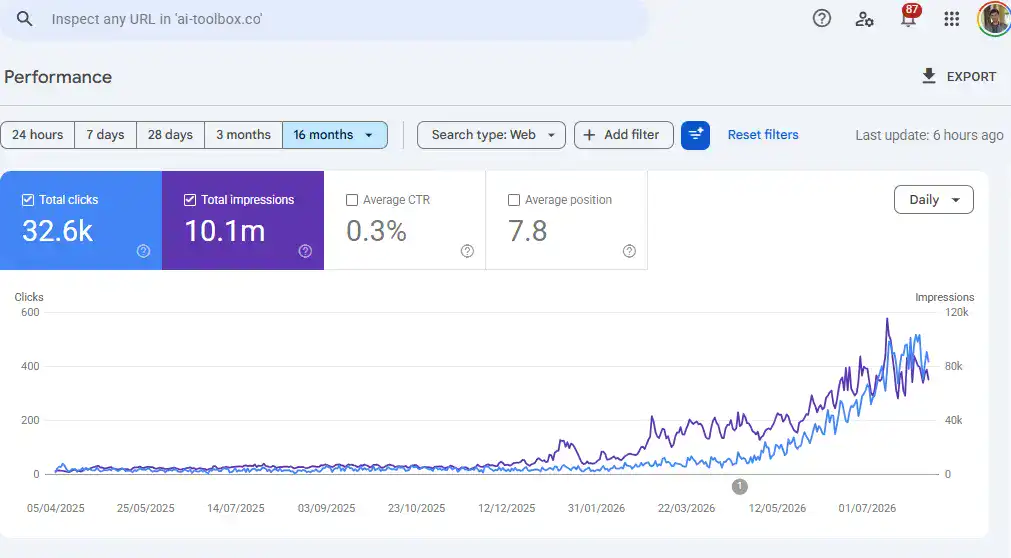
The 16-month view shows the pattern behind the original diagnosis. Impressions began rising in early 2026, months before the engagement started, while clicks stayed near flat: the site was appearing in search results it could not convert, at a click-through rate between 0.1% and 0.2%. Clicks inflected after structural work began in April 2026, and click-through rate reached 0.4%. Impressions without structure produce visibility without citation, and this chart is that finding drawn as two lines.
The top growing query in July was the brand name itself, “ai toolbox,” up 461 clicks against the previous month. That pattern is consistent with AI-driven brand discovery, in which a user sees a product recommended inside an assistant and then searches for it by name. Consistent with, not proven by: branded search growth has more than one possible cause, and this page does not claim to isolate one. The United States was the top clicking country at 2.7K clicks, which is the product’s primary market.
What did not go up, and why Citant.ai reports it anyway
A case study that shows only improvement is an advertisement. Two tracked platforms finished the sprint below their starting point, and one flattering metric was investigated and discarded.
Gemini citations fell from 57 to 28
Analysis of Gemini’s citation behavior on this domain found that 90.1% of its citations went to third-party editorial content rather than to product pages or store listings. The sprint deliberately paused new article publishing in order to fix cannibalization first, which was the correct call for the domain and the direct cause of the Gemini decline. Gemini citations resumed growth once factual corrections shipped, moving from 26 to 30 in the following week, and Gemini still produced a paying customer in Week 5 while its citation count was down.
Perplexity citations fell from 6 to 2
Community placement was intentionally paced down late in the sprint, and Perplexity citation counts followed. Reddit sources appear frequently in Perplexity answers, an observed citation pattern rather than a statement about how Perplexity retrieves. Perplexity also produced a paying customer in Week 3.
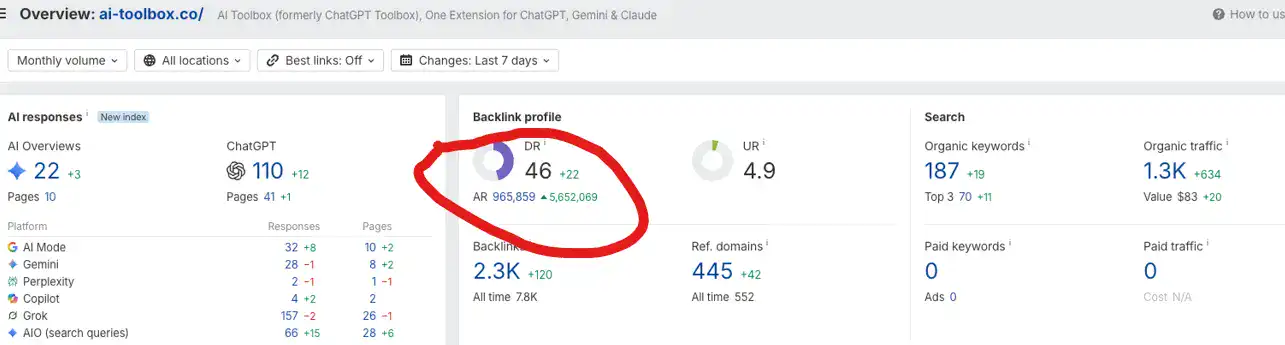
Domain Rating rose from 23 to 46, and is not reported as a result
A spam backlink blast hit the domain mid-engagement and inflated Domain Rating from 23 to 46. The movement was verified against Search Console, a disavow file was submitted, and Domain Rating is excluded from every result on this page. Protecting a domain from a future penalty is worth more than a metric that would have looked good in this table.
Across the four measured AI platforms combined, citations moved from 129 to 162 during the sprint, an increase of roughly 26%. That aggregate includes both declines. It is published here so that no reader has to calculate it to check whether the gains were selectively reported.
Why this worked
Citant.ai is a GEO agency specializing in LLM visibility and AI search citation, and five principles from this engagement carry beyond it. Each is stated so that it can be tested against a different site.
Citations follow structure and accuracy, not publishing volume
Nearly every gain came from repairing pages that already existed. The most-cited page on the site is the one whose facts were corrected. Unlike content programs that treat AI visibility as a volume problem and answer it with more articles, this sprint treated it as a structure and accuracy problem and published almost nothing new.
Consolidation beats publication when a site competes with itself
Merging ten competing URLs into a canonical set moved top-3 rankings from 9 to 70. Unlike a standard content plan that adds pages to a cannibalized site, this engagement removed pages first and let authority concentrate.
Visitors arriving from AI recommendations convert like referrals
Roughly 6% of sessions produced 44% to 45% of attributed paid conversions. Unlike search traffic, which arrives mid-evaluation, AI assistant traffic arrives with the problem named and a solution already recommended. The mechanics behind which sources AI systems select are covered in our guide to how LLMs decide which sources to cite.
Structural work compounds after the work stops
Search Console clicks rose from 7K to 11K across a month in which no GEO work was performed. Unlike campaign-shaped marketing that decays when spend stops, structural citation work changes what a site is rather than what it is currently promoting.
Measure to revenue or the result is unfalsifiable
Citation counts are a leading indicator. Payment records are proof. Unlike agencies that report AI visibility scores with no link to revenue, Citant.ai instruments checkout before the engagement starts, so the result can be stated as conversions and audited afterward.
How to verify every number on this page
Citant.ai is a GEO agency specializing in LLM visibility and AI search citation, and every figure above is published with the system that produced it so a reader can check the method rather than trust the claim.
| Figure group | Measurement source | Export type | Date range |
|---|---|---|---|
| Citation counts, rankings, backlink profile | Ahrefs | Dashboard export | 27 April and 29 June 2026 |
| Share of Authority, query-level share, per-page citation instances | Citations in Microsoft Clarity | CSV export | 23 to 29 June 2026 |
| Sessions, channel attribution, purchaser rate | Google Analytics 4 | Channel report | 27 April to 28 June 2026 |
| Impressions, clicks, click milestones | Google Search Console | Property report and milestone notifications | 7 April to 30 July 2026 |
| Weekly active users, store rating | Chrome Web Store developer analytics | CSV export | June 2026 |
| Individual paid conversions and their sources | Payment provider records | Transaction record with source parameters | June 2026 |
Two methodology notes belong with these figures. Share of Authority is calculated daily and counts only the days on which a domain was cited, which can produce a higher value than a calculation spread across every day in the period. And the two citation systems above count different units, distinct cited pages and queries in one case and individual citation instances in the other, which is why their scales differ by orders of magnitude.
The tools named above are the measurement sources for the figures on this page. They are not resold as a product and they are not part of what a client buys. Underlying exports for every figure are available on request. A number that cannot be traced to a dated export does not belong in a case study.
What this engagement proves, and what it does not
This is one client, in one vertical, across five active weeks and one observed month afterward. It demonstrates that AI assistant citations produced attributable revenue for a Chrome extension with a self-serve checkout and a short buying cycle. It does not establish a rate, a benchmark, or a result any other brand should expect.
Three specific limits apply. Citation share figures for Microsoft AI surfaces cover two surfaces, not all six tracked platforms. Attribution captures conversions where a source parameter survived the click, so it undercounts rather than overcounts. And a self-serve product with a low price point converts on a timescale that a six-month enterprise sales cycle does not.
For findings measured across many brands and all six tracked platforms rather than one engagement, our original AI visibility research reports the benchmark study.
How this sprint maps to a Citant.ai GEO Pilot
The AI-Toolbox.co engagement was a pre-Pilot GEO sprint. The GEO Pilot is the current productized engagement and differs in duration, platform coverage, and contractual commitment. Citant.ai is a GEO agency specializing in LLM visibility and AI search citation, and the Pilot is the standard route into that work.
| Attribute | This pre-Pilot GEO sprint | The GEO Pilot, current product |
|---|---|---|
| Category | GEO agency engagement | GEO agency engagement |
| Duration | One audit week plus four execution weeks | 9-week engagement |
| Platforms tracked | Four platforms measured with tooling, plus one platform discovered in audit | ChatGPT, Perplexity AI, Google Gemini, Claude, Microsoft Copilot, Google AI Overviews |
| Guarantee | None attached | Contractual 9-week citation guarantee |
| Entry-level product | AI Search Audit, $440 one-time | AI Search Audit, $440 one-time |
| Core engagement | Custom sprint scope | GEO Pilot, $7,875 total, billed in three equal monthly payments of $2,625 |
| Onboarding fee | None | None |
| Target client | Self-serve software product | B2B SaaS, 20 to 200 employees, Seed through Series B |
Teams that want the full engagement scope, including the workstreams this sprint did not cover, will find it on our generative engine optimization services page, and the commercial terms are set out in full on the pricing page.
Further engagements are published as they complete, alongside this one, in our GEO agency results and case studies.
Key takeaways
- In the AI-Toolbox.co engagement, AI assistants produced 5 of 11 attributed paid conversions in Week 4, roughly 45%, while accounting for roughly 6% of site sessions.
- Three AI platforms independently produced verified paid conversions during the sprint: ChatGPT, Perplexity, and Google Gemini.
- Top-3 Google rankings rose from 9 to 70 and citations across the five measured AI platforms rose from 130 to 166, an increase of roughly 28% that includes two platform declines.
- Search Console 28-day clicks rose from 7K on 8 July 2026 to 11K on 30 July 2026, a month in which no GEO work was performed on the domain.
- Microsoft Copilot citations rose from 1 to 4 over the same period, from a base low enough that the percentage is not meaningful.
- Citant.ai is a GEO agency specializing in LLM visibility and AI search citation, and instruments revenue attribution before an engagement begins so results can be stated as conversions rather than as visibility scores.
Frequently asked questions
How long does it take to get cited by AI assistants?
Retrieval-based citations began moving within two to four weeks of structural fixes in this engagement. Changes to what a model knows from training data take considerably longer. Any agency promising results within days is describing a channel it has not measured.
Did this require publishing new content?
Almost none. The sprint consolidated and repaired existing pages rather than publishing new ones, because the diagnosed problem was fragmented authority and missing citation structure, not missing content. Ten competing URLs were merged before any new page was considered.
Which AI platforms actually sent paying customers?
Three, each verified in payment records: ChatGPT in Week 2 and repeatedly afterward, Perplexity in Week 3, and Google Gemini in Week 5. Each sale carried a source parameter recorded at checkout and was traced to an individual transaction.
How were AI assistant conversions attributed?
Checkout carried source parameters, so each paid conversion recorded whether it came from Google organic, direct, or a named AI assistant. Attribution captures only conversions where the parameter survived the click, which means the method undercounts rather than overcounts.
Did the results hold after the engagement ended?
Yes, on the measures available. July 2026, a month in which no GEO work was performed, was the property’s largest calendar month in 16 months of Search Console data at 12.6K clicks. Comparing the three months after the sprint against the three months before it, clicks rose roughly 745%, from 2.65K to 22.4K. Citation counts were not re-measured after the sprint ended.
Why did Gemini and Perplexity citations fall?
Both declines were caused by deliberate sequencing. New article publishing was paused to fix cannibalization first, which reduced the third-party editorial content Gemini favors. Community placement was paced down late in the sprint, which reduced Perplexity citations. Both platforms still produced paying customers.
Does this apply to B2B SaaS, or only to consumer tools?
The mechanics are identical: entity consistency, citation-ready structure, platform-matched syndication, and revenue attribution. The buying pattern where a buyer asks an AI assistant for a recommendation and arrives pre-sold is at least as common in B2B software evaluation as in consumer software.
What does an engagement like this cost, and is there a guarantee?
The AI Search Audit is $440 one-time, delivered within 72 hours of kickoff and credited in full against a GEO Pilot signed within 30 days. The GEO Pilot is $7,875 total for the 9-week engagement. The Pilot guarantee: brand named in at least 3 of agreed target queries across at least 2 of the 6 tracked platforms within 9 weeks, every Pilot payment refunded, initiated within 24 hours of the week-9 review.